
Vision & Approach
Our Vision
The Food for Humanity Initiative envisions a just transformation of food systems that supports adaptive capacity to climate variability and change, promotes environmental sustainability, provides reliable livelihoods, ensures access to healthy diets, and optimizes better health and nutrition for everyone.
Food systems face unprecedented challenges. Climate change disrupts production, conflict fragments trade networks, and nearly 800 million people experience food insecurity despite abundant global production. Yet climate is only part of the story—economic shocks cascade through supply chains, geopolitics reshapes trade relationships, and migration transforms agricultural labor and food access. The complexity of these interconnected challenges demands sophisticated responses integrating climate science, network analysis, policy innovation, and agricultural practice.
Our 2025-2030 Strategy articulates this broad vision across health, agriculture, environment, equality, and justice.
→ Download the Executive Summary | Download the Strategy
Our Three-Pillar Approach
To build momentum and demonstrate impact, F4H is launching with three foundational pillars that leverage Columbia Climate School's unique strengths in climate science, complex systems analysis, and field research. This focused approach reflects strategic realism—concentrating initial efforts where we create genuine comparative advantage while positioning for expanded initiatives as partnerships and funding develop.
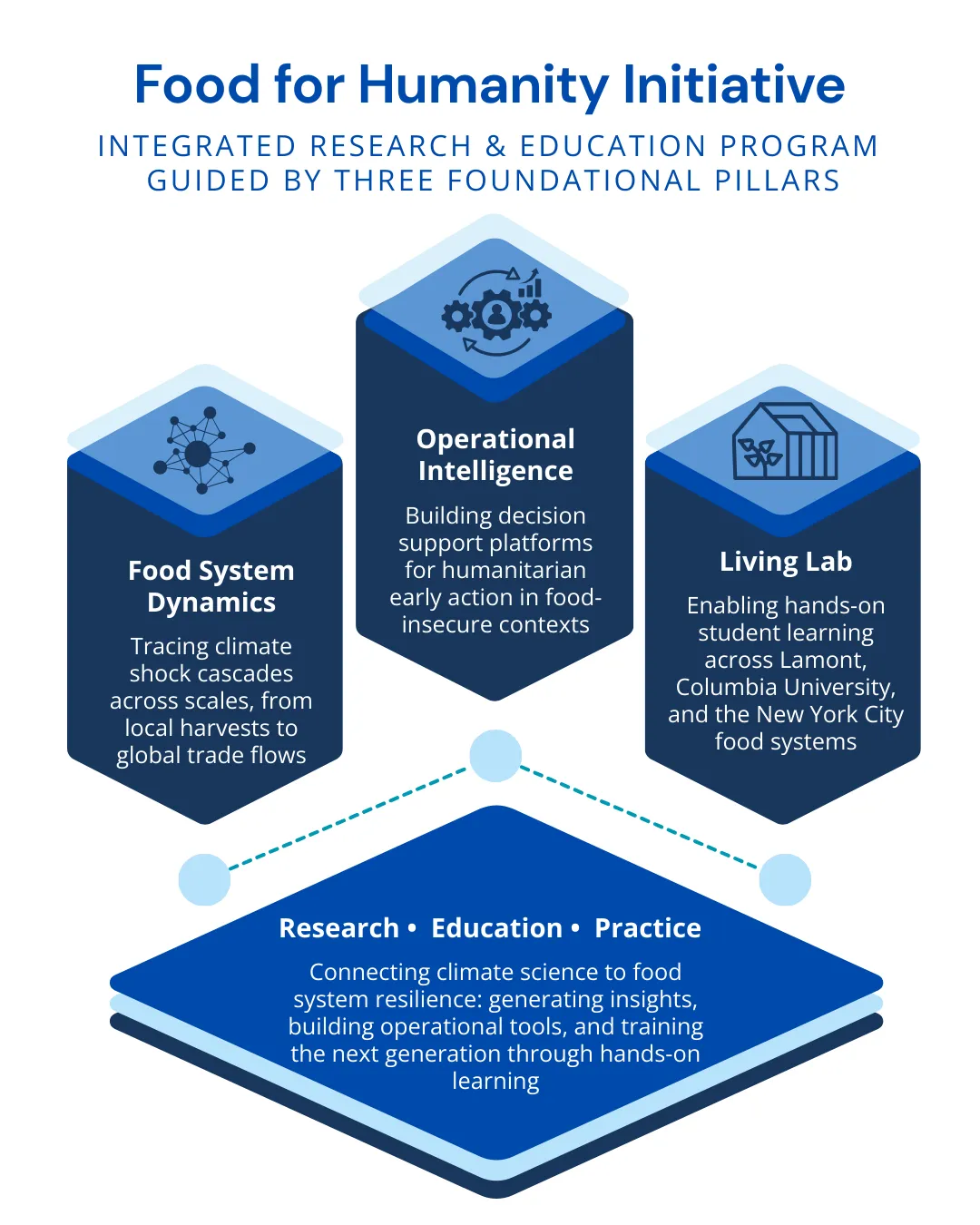
Food System Dynamics reveals how climate shocks cascade through interconnected networks — from local harvests to global trade flows — exposing vulnerabilities invisible to traditional analysis. Drawing on graph theory, dynamic modeling, and cross-scale systems analysis, we identify structural weaknesses and optimal intervention points across the full supply chain, generating insights that flow directly into decision support platforms for humanitarian early action in food-insecure contexts.
Operational Intelligence & Forecasting builds decision support across the full temporal spectrum — from coarse annual monitoring of country-level food system conditions to dynamic early warning systems enabling anticipatory humanitarian action. At the slower end, tools like food system dashboards track structural indicators across health, nutrition, and supply chains. At the faster end, demand-driven platforms like the Rethinking Early Warning initiative translate climate forecasts into timely, actionable intelligence for frontline decision-makers. Rather than pushing standardized alerts, we build locally-adapted tools that stakeholders can query and act upon — sustaining Columbia's 30-year operational forecasting legacy while expanding its reach across the full decision timeline.
Living Lab provides hands-on learning integrating climate science, AI, and food production. Beginning with AI-controlled greenhouses and pollinator research at Lamont campus, the Lab expands toward circular food systems spanning Columbia's campuses and NYC's urban food ecosystem. Students build forecasting tools, implement infrastructure projects, and learn by doing.
Why this works: The pillars create genuine synergies. Network vulnerability metrics feed operational platforms. Climate forecasts inform both humanitarian intelligence and agricultural experiments. Student experiences testing forecasts against real crops improve platform design. Together, they generate fundamental insights, translate them into operational platforms, and validate both through hands-on experimentation.