
Rethinking Early Warning
The world has more food security forecasts than ever. What it lacks is a reliable way to turn those forecasts into action.
Existing early warning systems generate signals, but they rarely translate into timely, authorized responses. The gap between a published warning and a funded, operationally ready intervention is where crises deepen. Rethinking Early Warning (REW) is designed to close that gap.
The approach
REW is built around a single premise: a trigger is only useful if it is calibrated to the specific decisions, constraints, and risk tolerance of the organization that has to act on it. A warning threshold that makes sense for WFP's logistics operations may be meaningless to a local nutrition program deciding whether to pre-position therapeutic food. Getting this right requires starting with institutions, not algorithms.
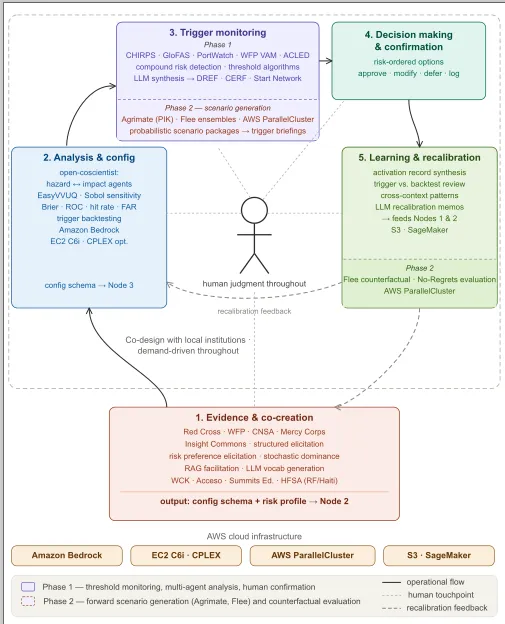
The REW system runs as a five-node cycle. It begins with structured consultation with local partners to elicit their decision criteria and risk preferences, and translates those into a machine-readable configuration that governs everything downstream. A multi-agent AI analytical pipeline then monitors compound indicators -- climate, food prices, conflict, shipping disruptions -- against institution-specific thresholds, packages evidence for human review, and learns from every activation decision to improve over time.
Human judgment is embedded at every stage of the cycle, not only at the final go/no-go decision. The system is designed to present the right options to the right analyst at the right moment, in a form that is both scientifically grounded and operationally usable under time pressure.
Team
REW is a multi-institutional initiative based within Columbia University's Food for Humanity Initiative.
Frank Riely is a co-founder of REW and brings decades of experience in famine early warning as a former senior analyst at FEWS NET, where he contributed to the development of the IPC scale and FEWS NET's analytical frameworks.
Shalean Collins, PhD, MPH, RD (Tulane University, Department of International Health and Sustainable Development) is an applied nutritionist whose research integrates food and water security, maternal-child health, and climate vulnerability. Her expertise anchors the nutrition-focused anticipatory action dimension of the Haiti pilot.
Benjamin Watkins (Tulane University) contributes to the humanitarian systems and decision-support dimensions of the REW framework.
Shouro Dasgupta (Euro-Mediterranean Center on Climate Change, CMCC; RFF-CMCC European Institute on Economics and the Environment) is a researcher specializing in the socioeconomic impacts of climate change on food security, labor, and inequality at multiple spatial scales.
Michael Puma (Columbia University) is a professor at Columbia University's Climate School, specializing in the modeling of food and other human systems.
Partner institutions: Tulane University, the London School of Economics (LSE), the Euro-Mediterranean Center on Climate Change (CMCC), and the Global Alliance for Improved Nutrition (GAIN).
We are seeking funding partners to support the transition from prototype to deployed system. If you are interested in supporting or collaborating on REW, please contact Prof. Michael Puma.